
Why Dealers Are Building Centralized F&I Departments
Discover how forward-thinking dealership groups are consolidating F&I operations into a single centralized hub — and why it may be the smartest move for your bottom line.
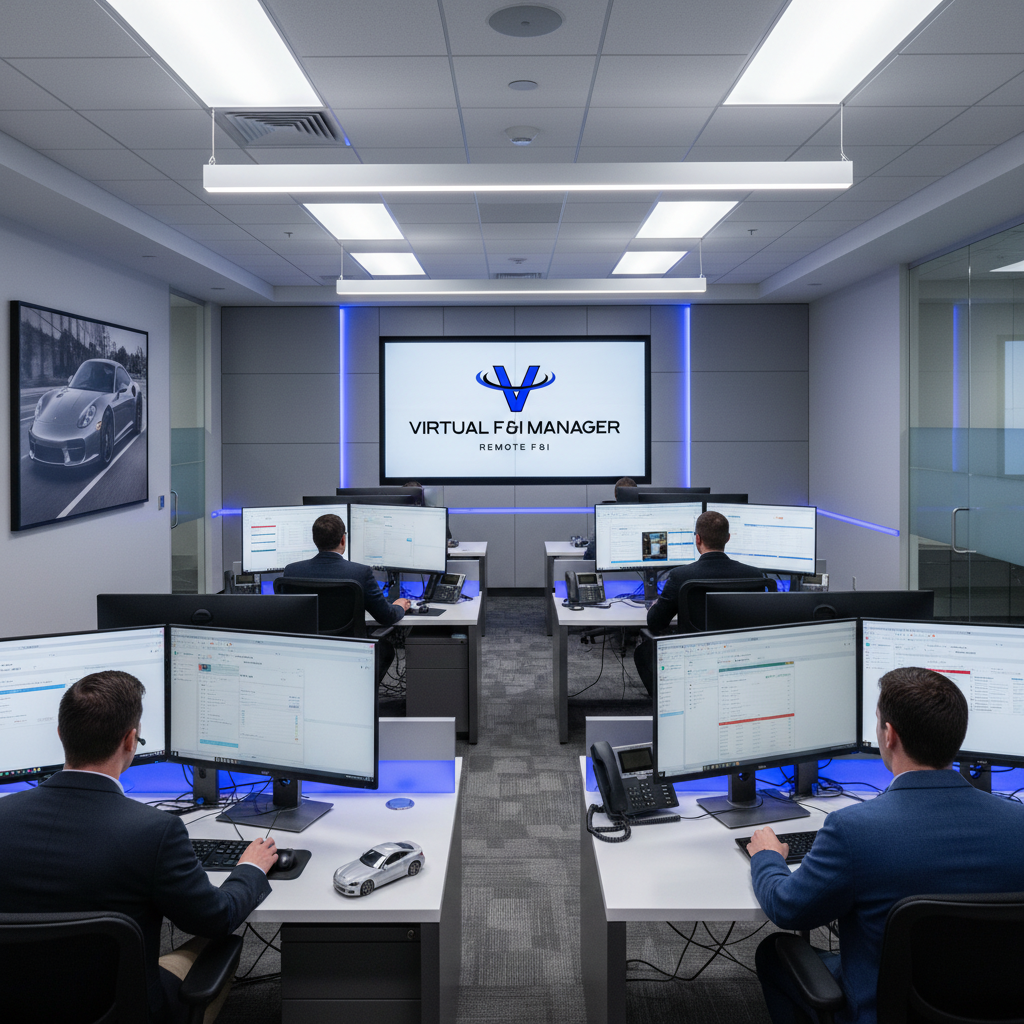
The traditional F&I model — one manager per rooftop, operating independently — made sense when dealerships were smaller and more isolated. But as dealer groups grow and the regulatory environment tightens, that siloed approach is starting to show its cracks.
More and more forward-thinking dealer principals are asking the same question: What if we ran F&I like a real department instead of a collection of individual performers?
The answer is a centralized F&I model, and it's quietly becoming one of the most powerful structural advantages in automotive retail.
What Is a Centralized F&I Department?
A centralized F&I department consolidates the finance and insurance function across multiple rooftops — or across an entire dealer group — into a single, coordinated operation. Instead of each store hiring, training, and managing its own F&I staff independently, the group creates a shared hub that serves all locations.
This hub can be physical (a central office that handles all deals remotely) or hybrid (a mix of on-site and remote coverage). Either way, the defining characteristic is unified oversight: one set of processes, one compliance standard, one training program, and one performance benchmark applied consistently across every deal.
The Problem with the Traditional Model
Before exploring the benefits of centralization, it's worth understanding why the old model creates friction.
Inconsistent performance. When each store manages its own F&I independently, performance varies wildly. One manager might average $1,800 PVR while another at a sister store averages $1,100. The difference often comes down to training, habits, and accountability — none of which are standardized in a siloed setup.
Compliance exposure. F&I is one of the most heavily regulated areas of a dealership. When each manager operates on their own, compliance practices drift. One store might have airtight menu presentation; another might be cutting corners without anyone noticing — until a regulator does.
Talent dependency. A single high-performing F&I manager can hold an entire store's backend revenue hostage. When they leave, the store scrambles. Centralization reduces this single-point-of-failure risk by distributing knowledge and process across a team.
Recruiting and retention costs. Finding qualified F&I managers is expensive and time-consuming. Dealer groups running siloed operations are constantly competing for the same limited talent pool, often overpaying to retain individuals who know they're irreplaceable.
The Case for Centralization
1. Standardized Compliance Across Every Deal
Compliance isn't optional — it's existential. A single CFPB complaint or FTC investigation can cost a dealer group far more than any backend revenue it ever generated.
A centralized F&I department allows you to implement one compliance framework and enforce it uniformly. Every deal goes through the same menu presentation, the same disclosure process, the same documentation standards. There's no guessing whether your Tulsa store is doing it right while your Dallas store cuts corners.
This is especially critical as the FTC's CARS Rule and state-level regulations continue to evolve. Centralized oversight means you can update your compliance protocols once and deploy them everywhere — immediately.
2. Higher and More Consistent PVR
Centralized teams tend to outperform siloed ones on per-vehicle retail (PVR) for a simple reason: they share what works.
When your best closer discovers a new objection-handling technique or a more effective way to present GAP, that knowledge stays in their head in a traditional model. In a centralized department, it becomes standard practice for everyone.
Add in consistent product training, regular performance reviews, and shared accountability metrics, and you create an environment where the floor rises for everyone — not just the stars.
3. Scalability Without Linear Headcount Growth
One of the most compelling financial arguments for centralization is the ability to scale without proportionally scaling your payroll.
In a traditional model, adding a rooftop means adding an F&I manager (or two). In a centralized model, your existing team can often absorb additional volume through better scheduling, remote deal-working, and process efficiency. You grow your footprint without growing your fixed costs at the same rate.
This is particularly powerful for dealer groups in growth mode — whether through acquisitions, open points, or new franchises.
4. Reduced Recruiting and Training Burden
Instead of each store independently sourcing, vetting, and onboarding F&I talent, a centralized department handles all of it in one place. You build a single training curriculum, a single onboarding process, and a single performance management system.
The result: faster ramp times for new hires, more consistent skill development, and a talent pipeline that serves the entire group rather than just one store.
5. Better Data and Reporting
Centralization creates a single source of truth for F&I performance data. Instead of piecing together reports from five different DMS instances, leadership gets a unified view of PVR, product penetration rates, compliance metrics, and chargebacks across every rooftop.
That visibility enables smarter decisions — whether it's identifying underperforming stores, spotting product mix opportunities, or catching compliance issues before they become legal problems.
What Centralization Actually Looks Like in Practice
There's no single blueprint for a centralized F&I department. The right structure depends on your group's size, geography, and deal volume. But here are the most common models:
Fully Remote Hub. All F&I is handled by a central team working deals remotely via video conferencing and digital contracting. This model works well for groups with high deal volume and strong digital retailing infrastructure.
Hub-and-Spoke. A central team handles overflow, training, and compliance oversight, while each store still has at least one on-site F&I manager. The hub provides backup coverage, quality control, and a career path for developing managers.
Traveling Team. A pool of F&I managers rotates across rooftops based on volume and scheduling needs. This model reduces fixed headcount while maintaining a physical presence at each store.
Many dealer groups use a hybrid of these approaches, adjusting coverage based on day-of-week volume patterns, seasonal fluctuations, and staffing availability.
The Role of Virtual F&I in Centralization
Virtual F&I services have become a natural complement to — and sometimes the foundation of — centralized F&I departments. Rather than building a central team from scratch, some dealer groups partner with a virtual F&I provider to handle overflow coverage, after-hours deals, or full remote department management.
This approach gives dealers the benefits of centralization — consistency, compliance, scalability — without the overhead of building and managing an internal team. It also provides a flexible on-ramp: dealers can start with virtual coverage for specific shifts or stores, then expand as they see results.
Is Centralization Right for Your Group?
Centralization isn't a one-size-fits-all solution. Single-point dealers with a strong, tenured F&I manager may not see enough benefit to justify the structural change. But for dealer groups with two or more rooftops — especially those experiencing inconsistent performance, compliance concerns, or high F&I turnover — the case is compelling.
The key questions to ask:
- Are your F&I results consistent across all stores, or is performance highly dependent on individual managers?
- Do you have a unified compliance standard, or does each store operate on its own?
- Are you losing backend revenue during open F&I positions or high-volume periods?
- Is your current F&I structure scalable as you add rooftops?
If the answer to any of these is "no" or "I'm not sure," centralization — whether built internally or through a virtual partner — is worth a serious look.
The Bottom Line
The dealerships that will win the next decade of automotive retail aren't the ones with the best individual F&I managers. They're the ones with the best F&I systems.
Centralization is how you build a system. It's how you take the institutional knowledge locked inside your top performers and turn it into a repeatable, scalable, compliant process that works across every deal, every store, every day.
The technology exists. The virtual infrastructure exists. The only question is whether your group is ready to make the shift.
Explore Topics
Written by
Virtual F&I Manager Team
Content creator and writer sharing insights and stories.